
How does an e-waste recycling machine work?
1. Introduction: Why E-Waste Recycling Technology Matters
Global e-waste generation is spiraling, creating an urgent environmental and economic challenge. Discarded electronics, everything from old phones to defunct servers are complex assemblies containing toxic substances (like lead and mercury) and valuable, finite resources (like gold, copper, and palladium). Less than 20% of global e-waste is formally recycled, with the majority ending up in landfills or being informally processed, which exposes workers to hazardous chemicals and results in the loss of valuable metals.
Advanced e-waste recycling machine technology is the critical solution. It moves beyond simple disposal, efficiently separating, processing, and recovering these materials. This technology is vital for reducing landfill waste, safeguarding the environment, and recovering billions of dollars worth of commodities.
Insights for this article are compiled from modern industry best practices and reputable sources, including the detailed processes developed by Respose India, a provider of specialized e-waste recycling plants.
2. Understanding the Structure of an E-Waste Recycling Plant
Modern e-waste processing utilizes a structured, three-level processing model to maximize recovery and compliance, showing how specialized machines work together to dismantle, size-reduce, and extract valuable metals.
3. Level 1: Dismantling and Classification
3.1 The Purpose of Level 1
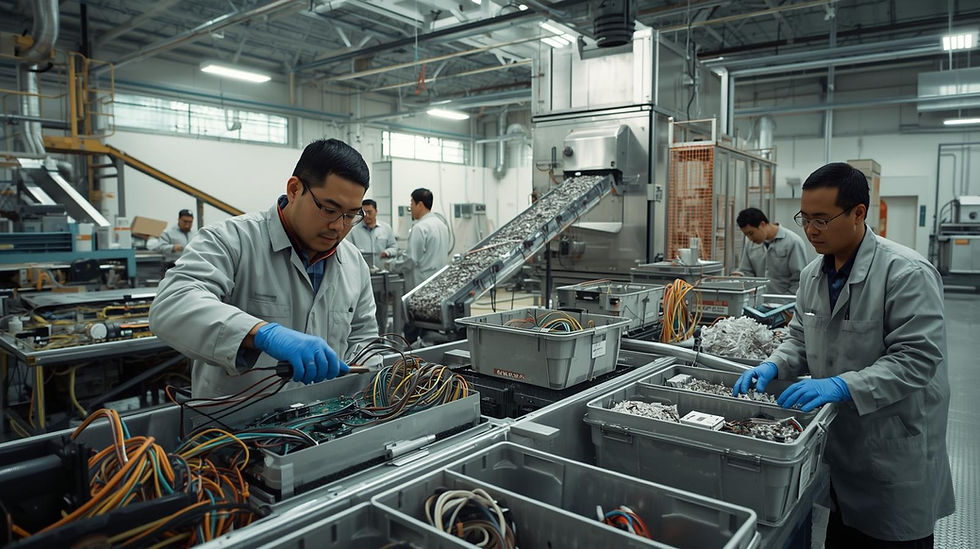
Level 1 is the essential pre-processing stage. The primary goal is to segregate different types of scrap before mechanical processing. This manual and semi-automated dismantling prevents damage to the downstream e-waste recycling machine components, isolates hazardous components (like batteries and bulbs), and drastically improves the purity of metal fractions entering Level 2.
3.2 Machinery Used in Level 1
Dismantling Lines: Specially designed worktables, often modular and connected by conveyors. They feature dust suction canopies for operator safety and dedicated bins for easy, error-free classification.
PCB Depopulation Machines: These essential units remove the tiny electronic components (ICs, MLCCs, capacitors, connector pins) from the Printed Circuit Boards (PCBs). The use of a depopulation machine, often equipped with a suction unit and fume scrubber, is key for recovering high-value components for Level 3 extraction.
Shredding Lines/Sheet Presses (Optional): Used primarily on large plastic cabinets and metal casings to reduce bulk, lowering storage requirements and transport costs.
3.3 Outputs of Level 1
The main outputs are clean, segregated streams: depopulated PCBs, separate component lots (ICs, connectors), wires, and casings. Classification at this stage is crucial as it increases the profitability of the entire plant by increasing the metal recovery efficiency in Level 2 and Level 3.
4. Level 2: Metal and Non-Metal Separation
4.1 Core Objective of Level 2
The core objective of Level 2 is the complete mechanical separation of non-ferrous metals (like copper and aluminum) from plastics and fiberglass using purely physical processes. Crucially, no chemicals are used in this stage, ensuring the process remains environmentally benign.
4.2 Main Machines Involved
The Level 2 process, often referred to as the "Rudra Family" plant in one industry example, is a complex line of specialized e-waste recycling machine components:
Shredding and Crushing: Depopulated PCBs, wires, and small electronics are fed into a Shredding Mill and potentially a Pre-Crusher to reduce the material size.
Magnetic Separation: As the shredded material moves along a conveyor, an Overband Magnetic Separator pulls out all ferrous metals (iron and steel).
Fine Granulation: The non-ferrous fraction moves to the Granulation Mill, which pulverizes the material, fully "liberating" the metal particles from the plastic and fiberglass.
Sizing and Sorting: The granulated material passes through a Cyclone Separator and then a Size Sorter. This sorter ensures uniform fraction sizes, returning oversized material to the granulator for re-grinding.
Density Separation: The final and most critical step uses a Metal Separator Assembly. This machine employs an air-driven fluidized bed density separation process. Since metal particles are significantly denser than plastic/fiberglass particles, the air stream effectively separates the heavier metal concentrate from the lighter non-metal fraction.
Source for Mechanical Separation Process: For a detailed review of the physical techniques used in this stage, including screening, magnetic, and density separation, see the paper: Mechanical recycling of waste electric and electronic equipment: a review
Throughout the mechanical process, Dust Collection and Air Purification Systems are provided at all potential dust generation points, collecting dust in filter bags for safe disposal.
4.3 Final Output
Level 2 yields clean, separated streams ready for sale or further refining: Clean metal concentrate (copper, aluminum, ferrous) and Non-metal fractions (fiberglass, resin powder, plastic).
5. Level 3: Precious Metal Extraction and Refining
5.1 Why Level 3 Exists
Level 3 is dedicated to recovering high-value metals Gold (Au), Silver (Ag), and Palladium (Pd) from the concentrated fractions (ICs, connector pins) produced in Level 1 and Level 2.
5.2 How the Extraction Process Works
This process utilizes hydrometallurgy, a chemical technique involving selective dissolution and extraction, optimized for high-value recovery:
Selective Dissolution: The concentrated precious metal sludge is first treated with dilute acids (e.g., dilute HCl) to dissolve highly reactive base metals, leaving the noble metals behind.
Aqua Regia Treatment: The remaining material is treated in a reactor with Aqua Regia (a powerful mixture of nitric and hydrochloric acids). Gold dissolves into the solution, while Silver typically precipitates as Silver Chloride.
Gold Precipitation: A displacement agent (like Sodium Metabisulphite or Zinc Powder) is added to the gold-bearing solution. This causes the gold to precipitate out as a solid Gold dust (cementation).
Final Smelting: The recovered Gold dust is collected via filtration and smelted into a pure Gold Nugget. Optional systems can be added to recover Palladium sponge.
Source for Hydrometallurgy Process: For technical details on this chemical extraction process, refer to the academic paper: Recovery of Gold from Electronic Scrap by Hydrometallurgical Process
5.3 End Products
The final products are highly refined and commercially valuable: Gold nuggets, Silver Chloride, and base metals like Copper and Aluminium recovered via smelting furnaces.
6. Additional Machines for Compliance and Safety
Apart from the core three-level process, regulatory bodies often mandate supplementary machinery to manage specialized and hazardous waste streams, further defining the complete e-waste recycling machine ecosystem.
Eddy Current Separator: Used for high-efficiency recovery of non-ferrous metals like aluminum from mixed streams.
Gas and Oil Recovery Systems: Essential for safely extracting and containing toxic Refrigerant Gas and oil from AC units and refrigerators.
Degausser / Data Wiping System: Mandated for securely destroying data on magnetic storage media to ensure data security compliance.
Baler / Hydraulic Press: Used to compact residual plastics and light metals for optimized storage and transport.
7. Safety, Environmental Compliance, and Pollution Control
Modern e-waste recycling machine operations prioritize safety and zero-emission compliance. The mechanical Level 2 process is inherently clean and free of polluting chemical emissions. Dust collectors and air filtration systems capture minute particles generated during shredding and granulation. The Level 3 hydrometallurgical process is conducted within contained reactors, using appropriate fume scrubbers and smoke stacks to ensure hazardous chemical agents are neutralized and not released into the environment.
To learn more about the broader environmental impact of e-waste recycling machine operations and resource conservation, the World Health Organization (WHO) offers valuable data on the health risks associated with informal recycling and the necessity of proper global standards.
8. Commercial Opportunities and ROI for E-Waste Recyclers
The three-level machine-based approach ensures a strong return on investment (ROI) by maximizing resource recovery:
Primary Revenue: The sale of high-purity precious metals (Gold, Silver, Palladium) and base metals (Copper, Aluminium) recovered in Levels 2 and 3.
Secondary Revenue: The sale of segregated plastics, casings, and reusable components from Level 1.
The modularity of systems allows recyclers to start with a capacity as low as 75 kg/hr and scale up to 500 kg/hr, reducing dependence on manual labor and increasing throughput dramatically.
9. Conclusion
The modern e-waste recycling machine represents a highly sophisticated, multi-stage facility that transforms electronic scrap into valuable, reusable resources. By adhering to the meticulous processes of dismantling, mechanical separation, and chemical refining, these systems not only ensure the safe handling of hazardous materials but also make a crucial contribution to the global circular economy by recovering critical materials.
For more information on the specialized machinery and plant setup, consult industry leaders like ResposeIndia: https://www.resposeindia.com/


Comments