
Why and How Should Local Governments Encourage Tyre Recycling Plants ?
- ResposeIndia
- Nov 14, 2025
- 6 min read

Introduction
Tyre Recycling in India is swiftly moving from a niche concept to a mainstream imperative as the nation grapples with a monumental waste challenge. India discards a staggering over 2.8 million metric tonnes of used tyres annually, creating an environmental crisis that demands immediate and innovative solutions. For local municipal bodies, this translates into severe operational headaches: landfills are reaching critical capacity, illegally dumped tyres become fuel for toxic fires, and clogged drainage systems lead to urban flooding. The need of the hour is a decentralized, efficient approach to managing this non-biodegradable waste. Establishing city-level tyre recycling plants, powered by advanced tyre recycling equipment, presents a transformative opportunity to convert this liability into a strategic asset. According to data from the Tyre Recycling Research Association of India (TRRAI) in 2023, of the ~2.8 million MT of tyre waste generated yearly, approximately 0.8 million MT is imported, further compounding the domestic disposal burden.
The Escalating Tyre Waste Problem in India
The issue of tyre waste in India is a multi-faceted problem with dire consequences. Beyond being a visual blight, discarded tyres have tangible and costly impacts:
Environmental Damage: Tires present a significant environmental challenge because they are non-biodegradable and can remain in the environment for centuries. Their bulky, hollow structure creates two major problems in landfills: they trap methane gas produced by decomposing waste, which causes them to become buoyant and "bubble up," damaging protective landfill liners. Additionally, when discarded, they readily collect standing water, creating an ideal breeding ground for mosquitoes and other pests, which poses serious public health risks.
Toxic Fires: When tyres catch fire whether accidentally or through intentional illegal burning they are incredibly difficult to extinguish and release a cocktail of dangerous pollutants, including carcinogenic polycyclic aromatic hydrocarbons (PAHs) and dioxins. The 2018 fire at the Bhalswa landfill in Delhi, which involved thousands of tyres, is a stark reminder of this danger, with air quality indices soaring to hazardous levels.
Economic Drain on Municipalities: Local municipalities face a substantial economic drain on their resources due to the cleanup and mitigation of illegal tyre dumping and frequent associated fires. A 2019 finding by the Central Pollution Control Board (CPCB) estimated that Indian cities spend roughly ₹150–200 crore annually to mitigate these issues. This financial burden is compounded by the inefficient management of waste, as only a meager 10–15% of waste tyres are properly recycled, resulting in the vast majority ending up in the informal sector or in dumpsites and representing a massive waste of potential resources.
Why Governments should Encourage Investments in Tyre Recycling
Local governments are the frontline administrators of waste management, making them the ideal catalysts for this change. The rationale for investment is compelling and spans economic, environmental, and social spheres.
Substantial Economic Benefits:
Revenue Generation: A single, mid-sized plant with a modern Tyre Recycling Machine in India can process 5,000 tonnes of waste tyres per year. The output crumb rubber, high-quality recovered steel, and pyrolysis oil can generate significant revenue. Crumb rubber alone, used in modified bitumen for roads, athletic tracks, and playground surfaces, can fetch ₹18-25 per kg. This can lead to total annual revenues of ₹10-15 crore, transforming a cost center into a profit center.
Cost Savings: By diverting tyres from landfills, municipalities can save crores in long-term landfill management and environmental remediation costs. This aligns with the principles of a circular economy, much like the evolving solutions for other complex waste streams, as discussed in the biggest problem with e-waste recycling in India and how we can fix it.
Profound Environmental Benefits:
Resource Conservation: Recycling tyres reduces the demand for virgin raw materials. For instance, the recovered steel can be used in construction, and the crumb rubber can replace virgin rubber in many applications, conserving natural resources.
Carbon Footprint Reduction: Using crumb rubber in road construction (as per the Indian Roads Congress guidelines) not only enhances the road's durability and resistance to water damage but also reduces the overall carbon footprint of the project.
Significant Job Creation and Skill Development:
Each tyre recycling facility serves as a significant hub for local employment, creating direct jobs in essential roles such as machine operation, maintenance, quality control, and administration. Crucially, the organized recycling sector also stimulates a parallel formalization of the collection supply chain. By establishing authorized collection networks and processing facilities, it creates economic opportunities for individuals involved in the initial sorting and transport of end-of-life tyres (ELTs) from retailers and garages. This transition provides these workers with better wages and significantly safer working conditions compared to highly unregulated waste streams.
The Technology Behind Tyre Recycling Machines
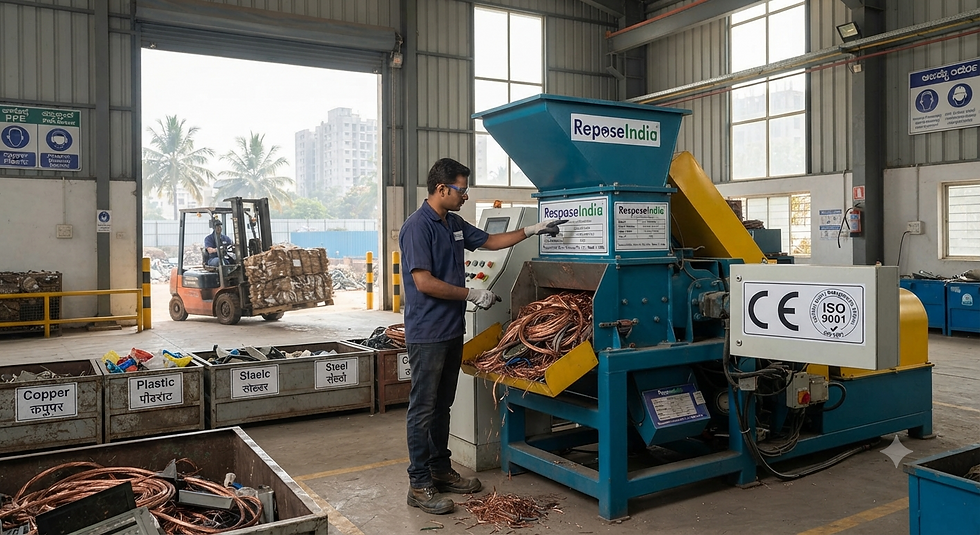
Modern tyre recycling equipment employs a sophisticated, multi-stage process to achieve near-total recovery of materials from waste tyres.
Primary Shredding: Whole tyres are fed into a powerful primary shredder that reduces them to 2-4 inch pieces.
Steel Separation: These pieces pass through a magnetic separator, which efficiently extracts the embedded steel wire (which constitutes about 15% of a tyre's weight). This steel is sold as high-quality scrap to the steel industry.
Secondary Processing (Granulation): The rubber chips are further processed in a granulator to produce fine crumb rubber of various mesh sizes (e.g., 10 mesh, 30 mesh) suitable for different industrial applications.
Pyrolysis (Advanced Recycling): For tyres that are too worn for other processes, pyrolysis is a game-changer. In an oxygen-free reactor, the rubber is heated to high temperatures, breaking it down into pyrolysis oil (an industrial fuel), carbon black (a reinforcing agent in rubber and plastic products), and syngas (which can be used to power the reactor itself). This technology ensures that even the most challenging tyre waste is valorised.
A Conducive Policy Environment and the PPP Opportunity
The Indian government has laid a strong policy foundation to spur this industry. The Extended Producer Responsibility (EPR) rules for tyres, notified by the MoEFCC in 2022, mandate that tyre producers ensure the environmentally sound management of their products once they reach end-of-life. This policy creates a guaranteed market and a source of funding for recycling operations.
For local governments, the most viable model is the Public-Private Partnership (PPP). Under this model:
The municipality can provide the necessary land, facilitate seamless logistics for tyre collection, and offer single-window clearance.
Private entities, bring in the capital investment, recycling technology providers such as ResposeIndia, supply the cutting-edge Tyre Recycling Machine in India, and also can bring in operational expertise.
The superior compliance and authorization rates for waste management in Maharashtra (98%) and Gujarat (92%) were highlighted in NGT proceedings as early as 2004, and more recently, in a 2022 Order (in O.A. No. 606/2018), which suggested other states should "study and learn from... [their] successes." This confirms the role of these states as precedents for successful private-sector involvement in waste processing. NGT Order dated July 7, 2022 - Item No. 01 (See Page 4, Paragraph 4 for the initial authorization rate reference).
Conclusion
In summary, supporting and enabling local tyre recycling plants is a strategic masterstroke for Indian Urban Local Bodies (ULBs). While ULBs may not directly invest in the machinery, their crucial role lies in partnering with the private sector by providing essential support like allotting suitable land, offering subsidies, and facilitating finance. This strategic partnership directly tackles a persistent waste problem, unlocks substantial economic value, creates green jobs, and positions cities as leaders in sustainable governance. By proactively integrating state-of-the-art Tyre Recycling Machines in India into their core solid waste management strategy, municipalities can effectively turn a tiresome problem into a trademark of circular economy success. The time for action is now; local governments must actively partner with the recycling industry to pave the way for a cleaner, greener, and more economically vibrant India.
Frequently Asked Questions (FAQs)
1. What is a Tyre Recycling Machine in India, and how does it work?
A Tyre Recycling Machine in India is a system designed to process end-of-life tyres into reusable materials. It typically involves shredding tyres into small chips, magnetically separating the embedded steel, and then further processing the rubber into crumb rubber or using pyrolysis to convert it into oil, carbon black, and gas.
2. Why is tyre waste such a big problem for Indian cities?
India generates over 2.8 million metric tones of tyre waste annually. This waste clogs drains, causes toxic fires, and occupies valuable landfill space. With only 10-15% of tyres being properly recycled, local governments face immense environmental and financial pressure in managing the rest.
3. What are the main products from a tyre recycling plant?
Modern tyre recycling equipment can produce several valuable commodities, including:
Crumb Rubber: Used in playground surfaces, sports tracks, and modified bitumen for roads.
Reclaimed Steel: Sold as scrap to the steel industry.
Pyrolysis Oil: A fuel alternative for industrial applications.
Carbon Black: Reused in the rubber and plastics industry.
4. How does tyre recycling support the "automobile recycling in India" ecosystem?
Automobile recycling in India aims for a circular economy by recovering materials from end-of-life vehicles. As tyres are a major component, efficient recycling through dedicated plants ensures that rubber and steel re-enter the supply chain, reducing waste and the need for virgin resources.
5. What government policies support tyre recycling in India?
The key policy is the Extended Producer Responsibility (EPR) for tyres notified by the MoEFCC in 2022. It makes tyre manufacturers responsible for the collection and recycling of used tyres, creating a structured market and encouraging investment in recycling infrastructure like Tyre Recycling Machines in India


Thanks
wrong-fuel-in-car.co.uk